Françoise Sullivan
For more than seven decades, Françoise Sullivan has shaped the history of performance and contemporary art in Quebec through a unique dialogue between the body and winter landscapes. This presentation brings together iconic images in which movement, snow, and light merge to form a vocabulary that continues to resonate today.
The gestures that shaped the history of performance in Québec.
Description of the exhibition
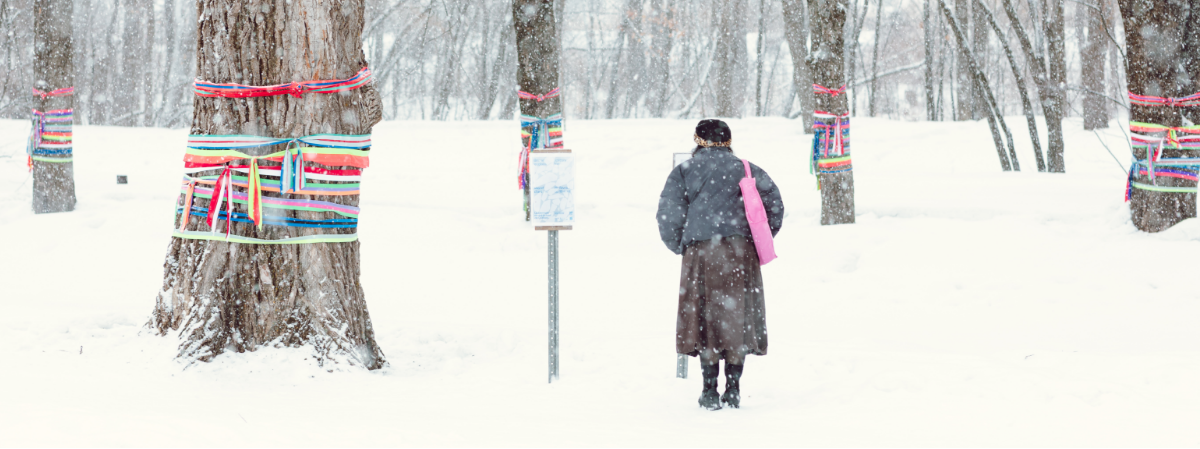
Throughout her career, Françoise Sullivan maintained an intimate relationship with Québec’s wintry landscape. In Danse dans la neige (1948), a landmark improvisation lasting from sunrise to sunset, she broke the surface of a snow-covered territory. Filmed by Jean-Paul Riopelle and photographed by Maurice Peron, Sullivan executed a series of gestures that would forever mark her as a pioneer of performance in the province and far beyond. In the images presented in this exhibition, we witness her feeling the topography of winter with her body, balancing and leaping from one moment to the next as the sun gradually moves through the sky. Mont-Saint-Hilaire, whose W8banaki name, Wigwômadenizibo, means “the small mountain in the shape of a house,” plays a central role here by framing Sullivan’s dance. Breaking the ice with her feet, she leaves a lasting mark.
Sullivan continued her movement work in a series of conceptually driven performances in which walking became a central aspect of her practice. This included Promenade parmi les raffineries de pétrole, an improvisational performance in and around Montréal’s oil refineries. Photographed by Alex Neumann, Sullivan posed in snow-capped scenery against pillars of industrialization, emblems of a soon-to-be oil crisis, and monuments to a greater environmental malaise. Executed nearly thirty years after Danse dans la neige, these works extended her exploration of wintry environments with her moving body.